This page illustrates the benefits of a code review with Collaborator. It shows how much time and money Collaborator is likely to save your team.
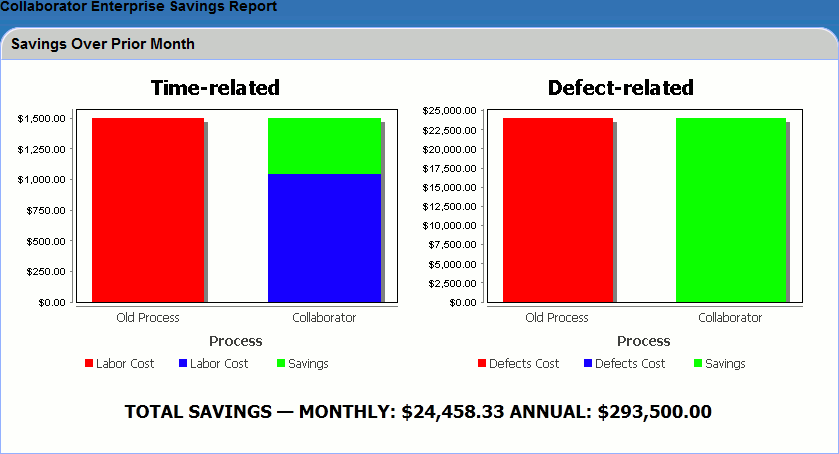
We find the following two metrics clear and easy to track.
| • | Labor Cost - Developer time saved by using Collaborator to do reviews. |
| • | Defects Cost - The cost to find and fix bugs discovered in QA or after product release with the cost to find and fix bugs found by Developers during code review. |
To export the Savings Report in a printable format, press PDF button in the upper-right corner.
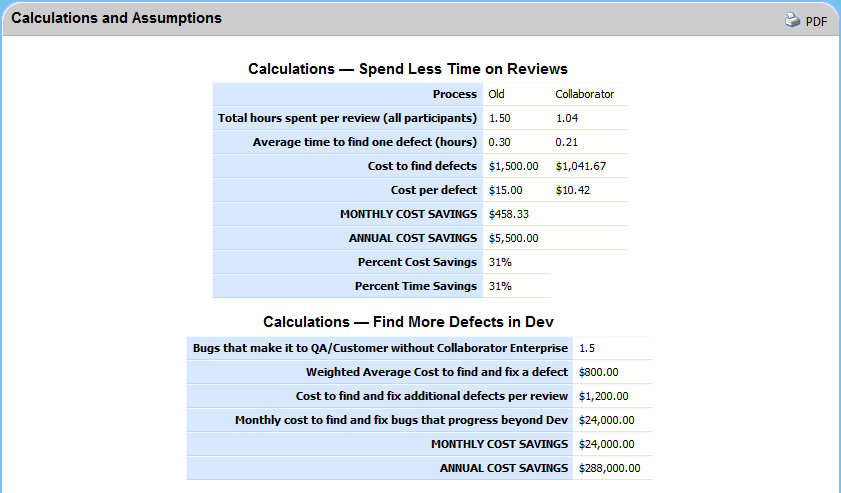
These data is calculated automatically. The default numbers come from industry-standard sources, including some of our own customer data.
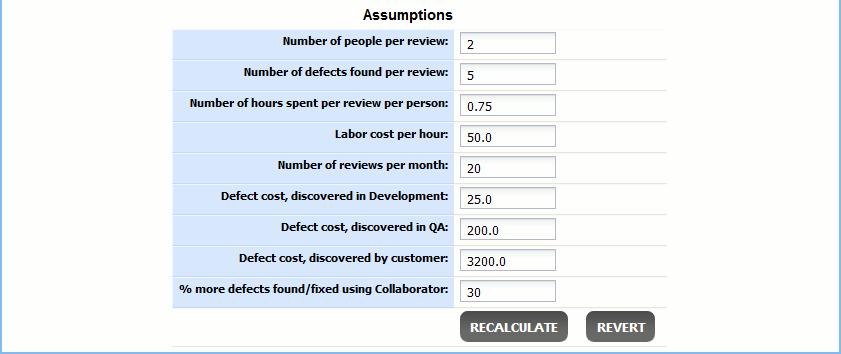
To get a personalized calculation, please specify the following initial data that better reflect your code review process:
Number of people per review |
Number of people that usually take part in one review. You can get Minimal and Minimal required number of participants from Role configuration settings. |
Number of defects found per review |
Average number of defects found in a single review. |
Number of hours spent per review per person |
How much time one person spends on a single review. Studies show that developers find a bug every 10-15 min with Collaborator. That is, 4.8 bugs in an hour. |
Labor cost per hour |
Average per hour salary of your developers. |
Number of reviews per month |
Average number of reviews in a month. Benchmark: Smart Bear's team of 5 developers does 75 reviews/month. For a team of 25, that review frequency would be 375 reviews per month. |
Defect cost, discovered in Development |
The cost of a defect found during development. Code review typically costs 30% that of QA because bugs are found faster and locations/methods of fixes are already identified. |
Defect cost, discovered in QA |
The cost of a defect found during quality assurance. |
Defect cost, discovered by customer |
The cost of a defect found in production. |
% more defects found/fixed using Collaborator |
How many defects were found by code reviews with Collaborator. We have chosen 30% as a default but feel free to change it. If your current code review process is not finding many bugs, then you should probably increase this value. |
When done, press Recalculate.
The Fun Facts section may help you in filling in the assumptions data as it displays the code review statistics within the previous 30 days.